Passive vs Active Income: Tax Treatment of Land Investments | Gauribidanur Guide
1. What's the Real Difference Between Passive and Active Income?
Think of it this way: active income is money you earn by actively working for it, while passive income flows in without your day-to-day involvement.
Active income from land happens when you're regularly buying and selling properties as a business—like a developer in Gauribidanur who purchases agricultural land, converts it to residential plots, and sells them within months. You're actively working on transactions, marketing, and dealing with buyers. The IRS sees this as business income, taxed at your regular income tax rate (which can go up to 37% for high earners).
Passive income from land is when you buy a plot and hold it for years, letting it appreciate. For example, if you bought a residential plot near Gauribidanur's upcoming infrastructure projects in 2020 and sold it in 2024 after the area developed, that profit is typically treated as a long-term capital gain—taxed at much friendlier rates of 0%, 15%, or 20%, depending on your income bracket.
2. The Gauribidanur Example: Two Investors, Two Tax Stories
Let me tell you about two people who invested in Gauribidanur, a town about 70 km from Bangalore that's seeing growth thanks to better connectivity and industrial development.
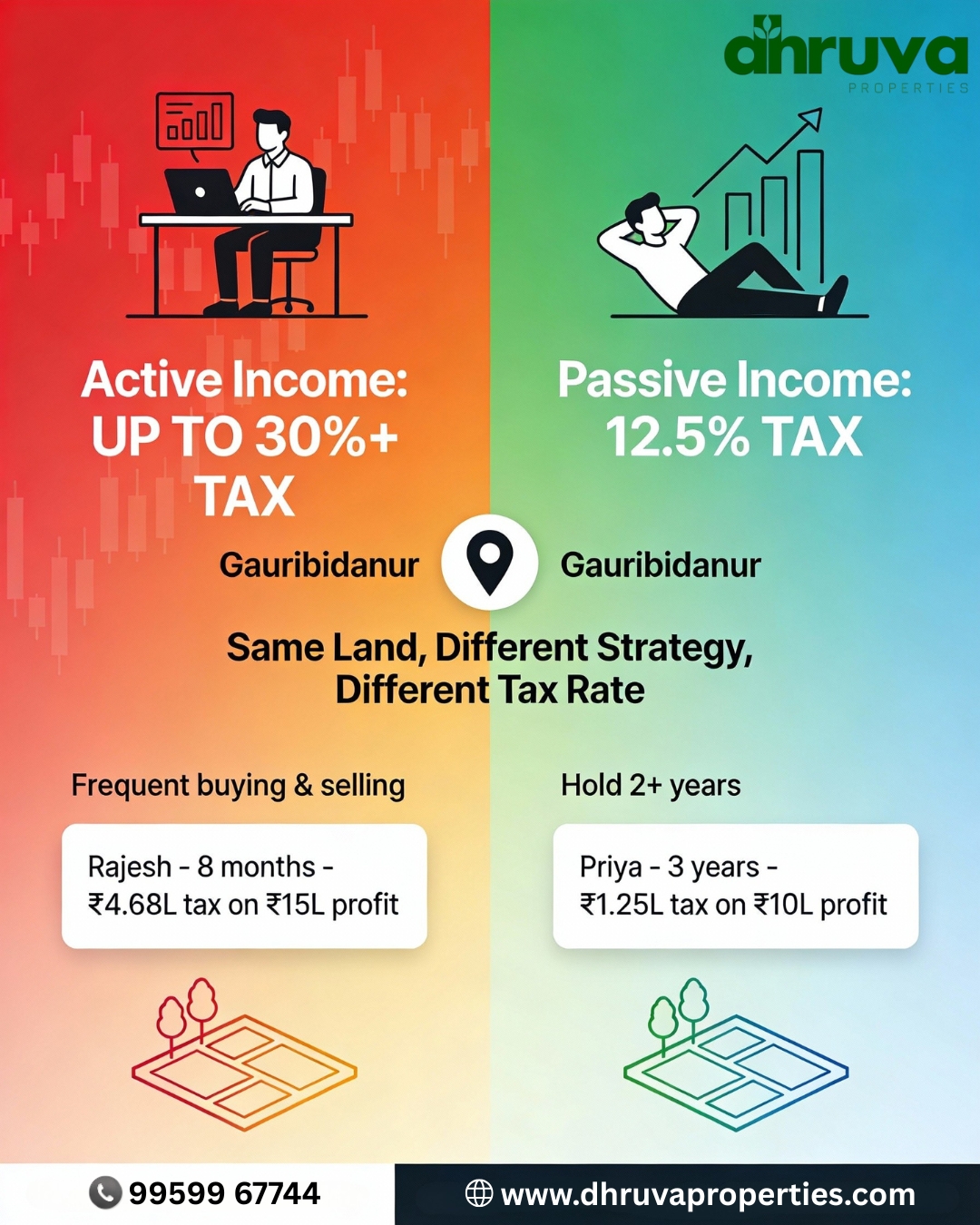
Rajesh's Active Approach: Rajesh quit his job to become a land dealer. He bought five plots near the Gauribidanur industrial area, got them surveyed and approved, then sold them within eight months. He made ₹15 lakhs profit. Since he was actively running this as a business, his profit was treated as regular business income and taxed at his income tax slab rate—let's say 30% plus cess. He paid around ₹4.68 lakhs in taxes.
Priya's Passive Investment: Priya, a software engineer, bought one plot in Gauribidanur in 2021 for ₹8 lakhs. She held onto it while working her regular job. By 2024, with new roads and a proposed logistics hub nearby, the plot's value jumped to ₹18 lakhs. She sold it for a ₹10 lakh profit. Since she held it for over two years and wasn't in the real estate business, her gain qualified as long-term capital gains—taxed at just 12.5% (new rate as of 2024). She paid ₹1.25 lakhs in taxes.
Same area, similar profits, but wildly different tax bills.
3. How to Structure Your Land Investment for Better Tax Treatment
Here's what actually matters to the IRS (and Indian tax authorities):
Holding period is king. Keep your land for at least two years to qualify for long-term capital gains treatment. Short-term gains (under 2 years) are taxed as regular income.
Frequency matters. If you're constantly buying and selling, you'll likely be classified as a dealer, not an investor. One or two strategic sales? You're probably safe as an investor enjoying capital gains treatment.
Your primary occupation counts. If you're a salaried professional who invests in land on the side (like Priya), it's easier to claim passive income treatment. If real estate is your full-time gig (like Rajesh), expect active income classification.
Document your intent. Keep records showing you purchased land for investment and appreciation, not for immediate resale. This includes holding onto property documents, not advertising the land for sale immediately, and showing a pattern of long-term holding.
4. Smart Moves to Keep Your Land Income Passive
Don't subdivide and develop unless you're ready to be treated as a developer. Simply holding raw land and selling it as-is keeps things simpler for passive treatment.
Limit your transactions. The more sales you make per year, the more you look like you're running a business rather than investing.
Consider the surrounding development. In places like Gauribidanur where infrastructure is improving, patience often pays off both in appreciation and tax savings. The longer you hold, the better your tax rate—and often, the higher your selling price.
Use 1031 exchanges (in the US) or similar provisions to defer taxes when selling one property and buying another. In India, you can reinvest capital gains in specified bonds or another residential property to claim exemptions under sections 54EC or 54F.