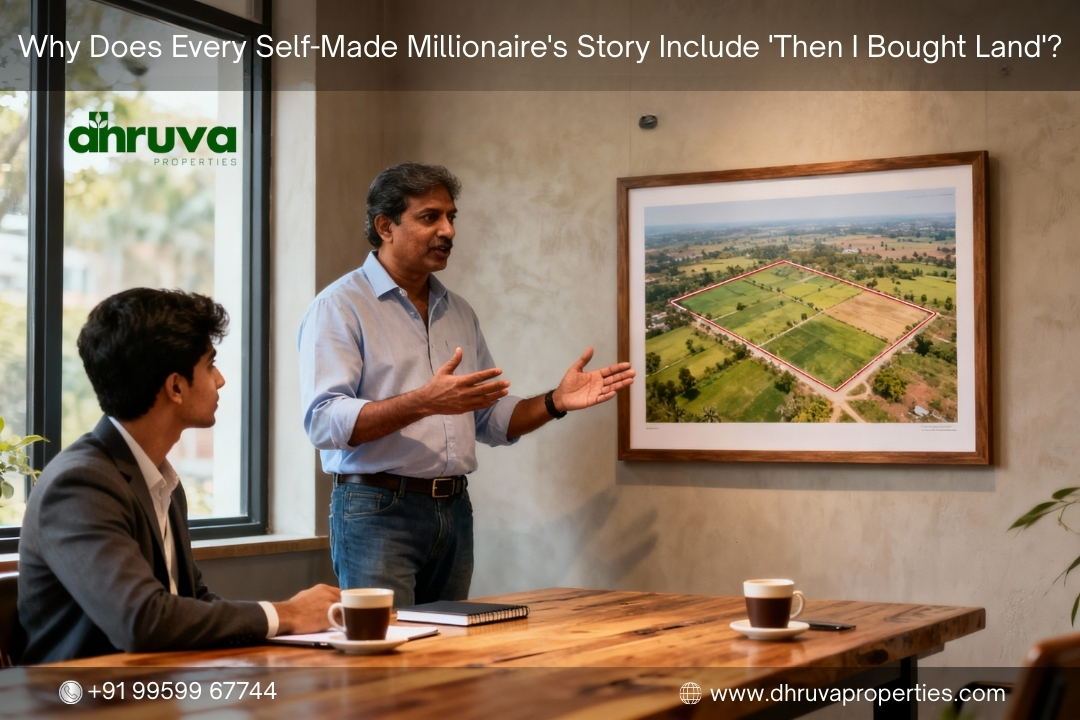
Why Does Every Self-Made Millionaire's Story Include 'Then I Bought Land'?
Land is the Wealth Consolidation Move
Here's what actually happens in a millionaire's journey:
Early stage: Hustle hard, build income, take risks, work constantly Middle stage: Income stabilizes, cash flow improves, patterns emerge Wealth stage: Buy land, consolidate gains, create lasting assets
Why land specifically?
Because everything else that made them wealthy required constant attention. The business needs management. Stocks need monitoring. Investments need decisions.
Land? Land just sits there. Appreciating. Requiring nothing.
Real pattern from actual millionaires:
"I made money in tech/business/profession. Then I secured it in land." The income-generating activity is risky and active. Land is the stable, passive wealth holder.
What this means for you:
You don't need to be a millionaire first. You can follow the pattern early. Places like Gauribidanur offer entry points where you can start building that stable asset base now, not after you've "made it."
Self-made millionaires aren't buying land because they're rich. They're rich partly because they bought land when they could afford to.
They Learned That Income Isn't Wealth—Assets Are
The realization every millionaire has:
Your salary can be ₹50 lakhs a year, but if you own nothing, you're not wealthy. You're just a high-earning employee. The moment you stop working, everything stops.
Why land becomes the answer:
It's the clearest separation between "making money" and "having wealth."
Your business can fail. Your job can end. Your startup can fold. But the land you bought in Gauribidanur or developing areas? Still there. Still appreciating. Still yours.
The shift in thinking:
Early in career: "How much do I earn?" After success: "What do I own?"
Land answers the second question in a way nothing else does. It's tangible. Can't be hacked, deleted, or bankrupted. Just physical asset that exists.
Why this matters:
Millionaires figured out that wealth is what remains when income stops. Land remains. Gadgets don't. Lifestyle expenses don't. Land does.
They Recognize Land as the Ultimate Inflation Hedge
What self-made millionaires understand about money:
Cash loses value over time. Inflation is constant. What costs ₹10 lakhs today will cost ₹15 lakhs tomorrow.
But land does something different:
It doesn't just hold value against inflation—it typically beats it. While your savings account gives 4% and inflation eats 6%, land in development corridors appreciates 15-20% annually.
The math they're doing:
₹50 lakhs in savings in 10 years = ₹50 lakhs (actually worth less due to inflation) ₹50 lakhs in land in 10 years = ₹1.5-2 crores (actually grown in real terms)
Why they choose land over other inflation hedges:
Gold requires storage. Stocks require monitoring. Business requires work. Land requires nothing but holding.
Real-world application:
That plot in Gauribidanur for ₹25 lakhs today? In 10 years, it's not just ₹25 lakhs sitting there. It's potentially ₹80 lakhs-₹1 crore. Your millionaire knows this pattern. That's why the land purchase always appears in the story.
Land Ownership Changes Decision-Making Forever
The psychological shift millionaires talk about:
Before owning land: "How do I earn more to sustain my lifestyle?" After owning land: "How do my assets work for me?"
Why this mindset change matters:
Land ownership forces long-term thinking. You can't day-trade land. Can't impulse-sell it. Can't panic during market dips.
It teaches patience. Strategic thinking. Delayed gratification. All traits that millionaires needed to become millionaires in the first place.
The compound effect:
First land purchase → Mindset shifts from consumer to investor → Makes better financial decisions across everything → Wealth accelerates
Why they say land "changed everything":
Not just because the land appreciated. Because owning land changed how they thought about every rupee they earned afterward.
Your opportunity:
You don't need to wait until you're successful to buy land. Buying land early might be part of what makes you successful. The mindset shift happens regardless of when you buy—early is actually better.
Land is the Generational Wealth They Want to Leave Behind
The uncomfortable truth millionaires face:
Your business might not survive you. Your investments might get squandered. Your money might get spent. But land? Land lasts.
Why land appears in every wealth story:
Because self-made millionaires are thinking beyond themselves. They built wealth from scratch. They know how hard it is. They want their children to start ahead, not from zero.
What land provides that nothing else does:
Physical permanence. Clear ownership. Appreciation over decades. Something concrete to inherit that can't be accidentally lost.
The pattern across generations:
Millionaire buys land → Land appreciates for 20-30 years → Next generation inherits significantly valuable asset → They have foundation millionaire didn't have
Why places like Gauribidanur matter in this context:
Affordable enough to buy now. Positioned in development paths (aerospace corridor, infrastructure growth). In 20-30 years? Your children inherit prime real estate you bought at early prices.
The real reason it's always in the story:
Self-made millionaires buy land not just for themselves—for the legacy they're building. It's the most reliable way to transfer wealth across generations.